

Coffee's global journey began not in Ethiopia, where the plant originates, but in Yemen, where Sufi mystics first cultivated and consumed it for religious purposes in the 15th century. Understanding this history is essential for anyone seeking to comprehend coffee's cultural meaning beyond contemporary commercial contexts. The beverage we now treat as productivity fuel began as a tool for spiritual practice.
Yemeni Sufis discovered that coffee enabled extended night prayers and meditation. The drink was called 'qahwa'—a term previously used for wine—suggesting that its consciousness-altering properties were immediately recognized. From monastic use, coffee spread to secular consumption in Yemen's port city of Mocha, which would give its name to both a coffee preparation and the port's primary export.
The coffeehouse (qahwa khana) emerged as coffee spread throughout the Ottoman Empire in the 16th century. These establishments became centers of social and intellectual life in ways that alarmed authorities. Ottoman sultans repeatedly attempted to ban coffeehouses, fearing them as spaces where political dissent could organize. The recurring pattern—prohibition followed by liberalization—indicates both coffee's social power and the impossibility of suppressing it.
The social functions of early coffeehouses merit attention. Unlike taverns, which encouraged intoxication and associated behaviors, coffeehouses promoted conversation and intellectual exchange. They became venues for poetry recitation, musical performance, chess and backgammon, and news dissemination. The coffeehouse created a new kind of public space—neither home nor marketplace, neither religious nor governmental—where men of different classes could mingle.
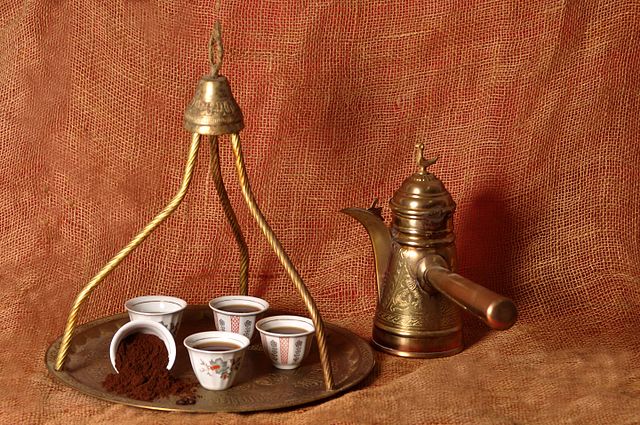
Coffee preparation in the Arab tradition emphasizes hospitality and ceremony. The distinctive ibrik or dallah (long-spouted pots), the cardamom and spices added to the brew, the small cups and multiple servings—these elements create a ritual structure similar to the Ethiopian ceremony, though with distinct regional variations. Refusing coffee offered by a host is a serious breach of etiquette across the region.
The pouring ritual itself carries meaning. The long spout of traditional pots enables pouring from height, aerating the coffee and demonstrating skill. The first cup is traditionally poured for the guest, the second for the host, and the third 'for the sword'—meaning continued drinking signals peaceful intentions. These conventions transform coffee service into communication, with each element carrying information beyond mere beverage delivery.
Colonial coffee cultivation eventually shifted global production to the Americas and Southeast Asia, marginalizing Yemen's role. Yet the Arab world's contributions to coffee culture endure in terminology (coffee itself derives from 'qahwa'), preparation methods, and the fundamental concept of the coffeehouse as public sphere. Every café worldwide owes something to these origins.
Contemporary Arab coffee culture maintains traditional elements while incorporating modern influences. In the Gulf states, Arabic coffee served with dates remains central to hospitality ritual even as specialty coffee shops multiply. In Lebanon and Jordan, traditional preparation coexists with specialty operations serving urban professionals. The tension between heritage and innovation plays out across the region in ways both creative and contested.
For contemporary specialty coffee, this history provides grounding. The current focus on Ethiopian genetics and African origins sometimes overlooks that coffee became a global commodity through Arab cultivation, trade networks, and cultural practices. Honoring this complete history enriches our understanding of what we drink.
Moreover, the Arab coffeehouse tradition reminds us that coffee's social power has been recognized—and periodically feared—for five centuries. The beverage's capacity to gather people, stimulate conversation, and create spaces for intellectual exchange has always been central to its cultural significance. Contemporary coffee culture that focuses exclusively on sensory characteristics misses this deeper heritage.
My reflection after studying Arab coffee history is that we stand in a long tradition of people finding in coffee something more than flavor. The Sufi mystics who first brewed it sought spiritual elevation. The Ottoman intellectuals who gathered around it sought community and conversation. The specialty coffee movement that analyzes its chemistry and terroir seeks its own meanings. All are legitimate engagements with a remarkable plant product.

Isabella Romano
Emma Johnson is a coffee expert with years of experience in brewing techniques, coffee culture, and the global coffee industry. She has extensive knowledge of coffee origins, roasting methods, equipment, and preparation practices, and regularly shares insights, guides, and tips to help enthusiasts and beginners enhance their coffee experience.
You Might Also Like
Comments
-
 Reply
ReplyIsabella Romano
Jun 23, 2025, 11:45 am
I’ve been experimenting with different brewing methods for a few months, and this guide really helped me understand the nuances between pour-over and French press. The tips on water temperature and grind size were especially useful. Thanks for sharing such a detailed article!
-
 Reply
ReplyRonda Otoole
Jun 23, 2025, 11:45 am
As a beginner, I often struggle with choosing the right coffee beans. This post broke down the flavor profiles clearly and gave practical advice on selecting beans based on taste preferences. I feel much more confident in my next purchase now.
 Reply
ReplyJames Whitley
Jun 23, 2025, 11:45 am
Loved the section about sustainable coffee practices! It’s great to see articles that not only focus on brewing but also educate readers on ethical sourcing and environmental impact. Definitely inspired me to try beans from local fair-trade roasters.
-
 Reply
ReplyKimberly Chretien
Jun 23, 2025, 11:45 am
I tried some of the latte art tips from this blog, and even though I’m still a beginner, my coffee looks way better now. The step-by-step instructions and real-world examples made it really easy to follow. Can’t wait to try more techniques!
-
 Reply
ReplyIsabella Romano
Jun 23, 2025, 11:45 am
I really appreciate how this post explains coffee concepts in a simple, approachable way. The breakdown of aroma, acidity, and body helped me understand why different coffees taste the way they do. It’s the kind of article I’ll come back to whenever I try a new bean.