


Consistency defines a signature blend's promise to consumers—the assurance that today's cup will deliver the character they experienced and enjoyed previously. Achieving this consistency requires systematic sensory evaluation that catches deviation before it reaches customers. Having developed and managed sensory evaluation programs for blend consistency, I share methodologies that reliably maintain the character that signature blends must deliver.
The reference standard establishes the target against which production is evaluated. Without a defined reference, consistency evaluation becomes subjective—different evaluators applying different standards to produce inconsistent judgments. A properly established reference standard provides the objective benchmark that enables reliable consistency assessment.
I establish reference standards from production batches that achieve target profile during blend development. These reference samples represent what the blend should taste like—the specific balance, intensity, and character that defines this particular signature. Reference samples should be stored to preserve character: freezing in airtight containers minimizes degradation, providing stable references for extended periods.
Multiple reference samples at different ages can be useful. Fresh reference shows optimal character; aged reference shows acceptable evolution. Production falling within this range demonstrates acceptable consistency; production deviating beyond these references signals problems requiring investigation.
Evaluation protocol structures how comparison to reference occurs. Consistent protocol ensures that evaluations are comparable across sessions and evaluators—that observed differences reflect coffee differences rather than procedural variation. Standardized cupping protocols provide the methodological foundation; blend-specific adaptations optimize for particular evaluation needs.
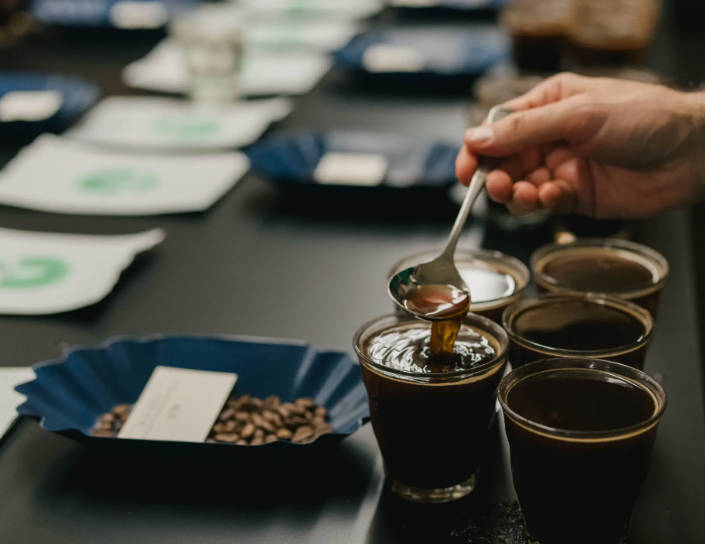
I conduct blend consistency cupping with reference samples included in every session, presented blind alongside production samples. This blind comparison eliminates bias that knowing which sample is reference might introduce. Production that matches reference passes; production that diverges requires investigation to determine cause and appropriate response.
Attribute-specific evaluation captures more information than overall assessment alone. Rather than just judging whether production matches reference, evaluate specific attributes: Does acidity match in type and intensity? Does sweetness present comparably? Does body weight and texture align? Does aftertaste mirror the reference? This attribute breakdown identifies specifically where deviation occurs, guiding corrective action.
I use evaluation forms that score attributes independently before overall assessment. A production batch might match reference on body and sweetness but diverge on acidity—information that would be lost in pure overall comparison. This attribute detail enables targeted investigation rather than general troubleshooting.
Deviation investigation determines whether observed differences reflect real problems requiring action or acceptable variation requiring no response. Not all measured differences are meaningful; sensory evaluation involves inherent variation that statistical approaches can quantify. Establishing acceptable variation ranges—based on replication testing that characterizes evaluation precision—distinguishes significant deviation from noise.
I conduct replicated evaluation of reference samples to characterize baseline variation. If repeated evaluation of the same sample produces 0.3-point score variation, a production sample deviating by 0.3 points from reference may fall within normal evaluation uncertainty rather than indicating actual product drift. Setting action thresholds above baseline variation prevents over-reaction to measurement noise.
Root cause analysis for confirmed deviation investigates what caused the problem and how to prevent recurrence. Potential causes include component variation (different lot characteristics), roast variation (profile deviation), blending errors (incorrect ratios), storage issues (degradation), or environmental factors (humidity, temperature affecting evaluation). Systematic investigation considers each possibility.
I maintain documentation that connects production batches to components used, roast parameters recorded, and blending logs. When deviation occurs, reviewing this documentation can identify suspect factors for focused investigation. A batch with unusual acidity might correlate with a new component lot; one with muted character might correlate with extended storage.
Corrective action responds to confirmed deviation appropriately. Minor deviation might be released with monitoring; moderate deviation might require ratio adjustment or profile modification; severe deviation might require rejection. The appropriate response depends on deviation magnitude, cause identification, and correction feasibility.
I establish decision rules for deviation response that production staff can apply without case-by-case deliberation. These rules specify what deviation levels trigger what actions—creating consistent, timely responses rather than inconsistent ad hoc judgments.
Calibration maintains evaluator alignment over time. Individual perception drifts; evaluation panels can develop collective biases that diverge from original reference understanding. Regular calibration sessions using defined reference samples and external standards recalibrate evaluators to shared standards.
I schedule monthly calibration sessions where evaluators cup reference samples and discuss their evaluations. When individual assessments diverge from group consensus or historical reference, discussion identifies the cause—whether reference understanding has shifted, individual calibration has drifted, or genuine disagreement exists about attribute interpretation. This ongoing calibration maintains consistent evaluation over time.
Documentation creates institutional knowledge that survives personnel changes and enables continuous improvement. Recording every evaluation session—samples assessed, scores assigned, deviations observed, actions taken—builds a database that informs future operations. Patterns emerge from accumulated data that individual sessions cannot reveal.
I review consistency data quarterly, looking for patterns: Does deviation correlate with specific component sources, particular production equipment, certain operators, or seasonal factors? These patterns identify systemic issues that address root causes rather than symptoms. Continuous improvement emerges from this systematic review rather than reactive problem-solving.
My conclusion from managing blend consistency through sensory analysis is that the methodology matters as much as the evaluator skill. Even expert evaluators produce inconsistent judgments without systematic protocols; even basic evaluators achieve useful consistency with proper methods. Establishing clear references, applying consistent protocols, analyzing deviations systematically, and documenting comprehensively transforms consistency evaluation from subjective impression to reliable quality system. This systematic approach enables the consistency that signature blends must deliver to fulfill their promise to consumers.

Sophia Reynolds
Emma Johnson is a coffee expert with years of experience in brewing techniques, coffee culture, and the global coffee industry. She has extensive knowledge of coffee origins, roasting methods, equipment, and preparation practices, and regularly shares insights, guides, and tips to help enthusiasts and beginners enhance their coffee experience.
You Might Also Like
Comments
-
 Reply
ReplySophia Reynolds
Jun 23, 2025, 11:45 am
I’ve been experimenting with different brewing methods for a few months, and this guide really helped me understand the nuances between pour-over and French press. The tips on water temperature and grind size were especially useful. Thanks for sharing such a detailed article!
-
 Reply
ReplyRonda Otoole
Jun 23, 2025, 11:45 am
As a beginner, I often struggle with choosing the right coffee beans. This post broke down the flavor profiles clearly and gave practical advice on selecting beans based on taste preferences. I feel much more confident in my next purchase now.
 Reply
ReplyJames Whitley
Jun 23, 2025, 11:45 am
Loved the section about sustainable coffee practices! It’s great to see articles that not only focus on brewing but also educate readers on ethical sourcing and environmental impact. Definitely inspired me to try beans from local fair-trade roasters.
-
 Reply
ReplyKimberly Chretien
Jun 23, 2025, 11:45 am
I tried some of the latte art tips from this blog, and even though I’m still a beginner, my coffee looks way better now. The step-by-step instructions and real-world examples made it really easy to follow. Can’t wait to try more techniques!
-
 Reply
ReplySophia Reynolds
Jun 23, 2025, 11:45 am
I really appreciate how this post explains coffee concepts in a simple, approachable way. The breakdown of aroma, acidity, and body helped me understand why different coffees taste the way they do. It’s the kind of article I’ll come back to whenever I try a new bean.