
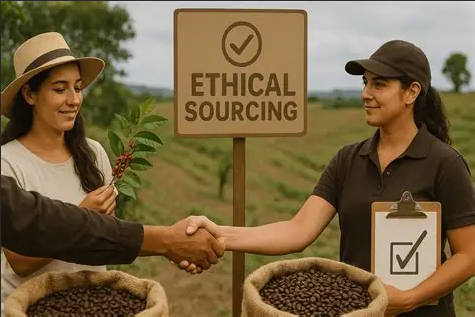
Ethics and transparency in signature blend sourcing represent both moral imperatives and strategic advantages. The choices made about how components are sourced—what relationships they emerge from, what practices they support, and what information is shared with consumers—shape not only the coffee's quality but the brand's credibility and the industry's trajectory. Having navigated these considerations across numerous blend programs, I share perspective on integrating ethical practice and transparent communication into blend sourcing.
The ethical sourcing challenge for blends involves complexity that single origin programs avoid. A single origin coffee can be traced to specific producer relationships where ethical practice can be directly verified. A blend combining multiple origins creates accountability challenges: maintaining ethical standards across multiple supply chains, verifying practices at multiple sources, and communicating accurately about multiple relationships.
I approach blend ethics through systematic verification rather than assumption. For each component, what do we actually know about production practices? Is that knowledge based on direct observation, supplier representation, certification, or assumption? This honest assessment reveals where ethical confidence is justified and where additional verification is needed.
Fair pricing represents a fundamental ethical consideration. Are the prices paid for blend components sufficient to support sustainable livelihoods for producers? This question requires understanding production costs, not just market rates. A price that seems premium compared to commodity benchmarks might still leave farmers unable to invest in their farms or families.
I calculate whether component prices support living wages and farm investment for producers. This requires information about production costs in specific origins—information that supply chain relationships can provide. When analysis suggests prices are insufficient, that creates an ethical choice: pay more, seek more efficient sources, or accept that the blend is built on unsustainable producer economics.
Sustainability practices at origin affect long-term supply and environmental impact. Are component sources implementing practices that protect soil health, water resources, and ecosystem function? Or are they extracting value now while degrading future productive capacity? Blends dependent on unsustainable production face both ethical problems and practical supply risks.
I evaluate component sources for sustainability practice alongside quality and commercial factors. Direct relationships enable observation of actual practices; certifications provide third-party verification; supplier representations require trust assessment. The goal is reasonable confidence that components come from production systems that can continue without degradation.
Labor conditions deserve attention that commodity supply chains often neglect. Coffee production depends on human labor—particularly seasonal harvest labor that may involve vulnerable populations. Are workers treated fairly? Are conditions safe? Is compensation adequate? These questions are difficult to answer from consuming-country distance but essential for ethical sourcing claims.
I seek information about labor practices from supply chain partners and verify when possible through origin visits. Perfect information is rarely available, but distinguishing between sources with transparent labor practices and those that resist scrutiny enables informed component selection. Choosing sources with demonstrated commitment to fair labor over those with unknown or problematic practices represents meaningful ethical progress.
Transparency with consumers involves honest communication about what we know and do not know about component sourcing. The temptation to claim more certainty than exists—to market blends as ethically exemplary when verification is incomplete—undermines long-term credibility. Consumers increasingly detect and punish misleading claims.
I advocate for transparency calibrated to actual knowledge. Communicate clearly what is verified, what is supplier-represented, and what remains uncertain. This honest positioning may seem less compelling than confident ethical claims, but it builds trust that survives scrutiny. As verification capabilities improve, communication can become more comprehensive.
Component traceability enables transparency by maintaining information flow from origin to consumer. Each component should carry documentation identifying its source, the relationship through which it was acquired, and what is known about production practices. This documentation trail enables answering consumer questions accurately rather than fabricating responses.
I implement traceability systems that capture component provenance and ethical information at sourcing, maintain that information through production, and make it accessible for consumer communication. This systematic approach ensures that marketing claims can be substantiated rather than representing aspirational fiction.
Verification mechanisms provide confidence that claimed practices actually occur. Third-party certifications offer independent verification with varying rigor. Direct observation during origin visits provides firsthand evidence. Supplier audits and documentation review enable assessment without travel. The appropriate verification approach depends on risk level and resource availability.
I use risk-based verification, applying more intensive verification to higher-risk sources and accepting lower verification levels for established relationships with demonstrated track records. This approach allocates verification resources efficiently while maintaining meaningful standards.
Continuous improvement reflects that ethical sourcing is a journey rather than a destination. Perfect supply chains do not exist; the question is whether practices are improving over time. Documenting current practices, setting improvement targets, and measuring progress demonstrates genuine commitment more convincingly than static claims of excellence.
I establish improvement goals for blend sourcing programs: increasing verified ethical sourcing percentage year-over-year, deepening relationships with producers to enable better practice verification, and expanding traceability capabilities. This improvement orientation transforms ethical sourcing from checkbox compliance to genuine commitment.
My conclusion from integrating ethics and transparency into blend sourcing is that these elements serve both moral and commercial purposes. Consumers increasingly value ethical products and can detect inauthentic claims. Brands that build genuine ethical practices and communicate them honestly create competitive advantages that performative ethics cannot match. The blend programs that will thrive long-term are those where ethical sourcing and transparent communication are embedded in operations rather than layered on as marketing. This integration requires investment and commitment, but the returns—in brand credibility, consumer loyalty, and industry contribution—justify that investment.

Daniel Carter
Emma Johnson is a coffee expert with years of experience in brewing techniques, coffee culture, and the global coffee industry. She has extensive knowledge of coffee origins, roasting methods, equipment, and preparation practices, and regularly shares insights, guides, and tips to help enthusiasts and beginners enhance their coffee experience.
You Might Also Like
Comments
-
 Reply
ReplyDaniel Carter
Jun 23, 2025, 11:45 am
I’ve been experimenting with different brewing methods for a few months, and this guide really helped me understand the nuances between pour-over and French press. The tips on water temperature and grind size were especially useful. Thanks for sharing such a detailed article!
-
 Reply
ReplyRonda Otoole
Jun 23, 2025, 11:45 am
As a beginner, I often struggle with choosing the right coffee beans. This post broke down the flavor profiles clearly and gave practical advice on selecting beans based on taste preferences. I feel much more confident in my next purchase now.
 Reply
ReplyJames Whitley
Jun 23, 2025, 11:45 am
Loved the section about sustainable coffee practices! It’s great to see articles that not only focus on brewing but also educate readers on ethical sourcing and environmental impact. Definitely inspired me to try beans from local fair-trade roasters.
-
 Reply
ReplyKimberly Chretien
Jun 23, 2025, 11:45 am
I tried some of the latte art tips from this blog, and even though I’m still a beginner, my coffee looks way better now. The step-by-step instructions and real-world examples made it really easy to follow. Can’t wait to try more techniques!
-
 Reply
ReplyDaniel Carter
Jun 23, 2025, 11:45 am
I really appreciate how this post explains coffee concepts in a simple, approachable way. The breakdown of aroma, acidity, and body helped me understand why different coffees taste the way they do. It’s the kind of article I’ll come back to whenever I try a new bean.